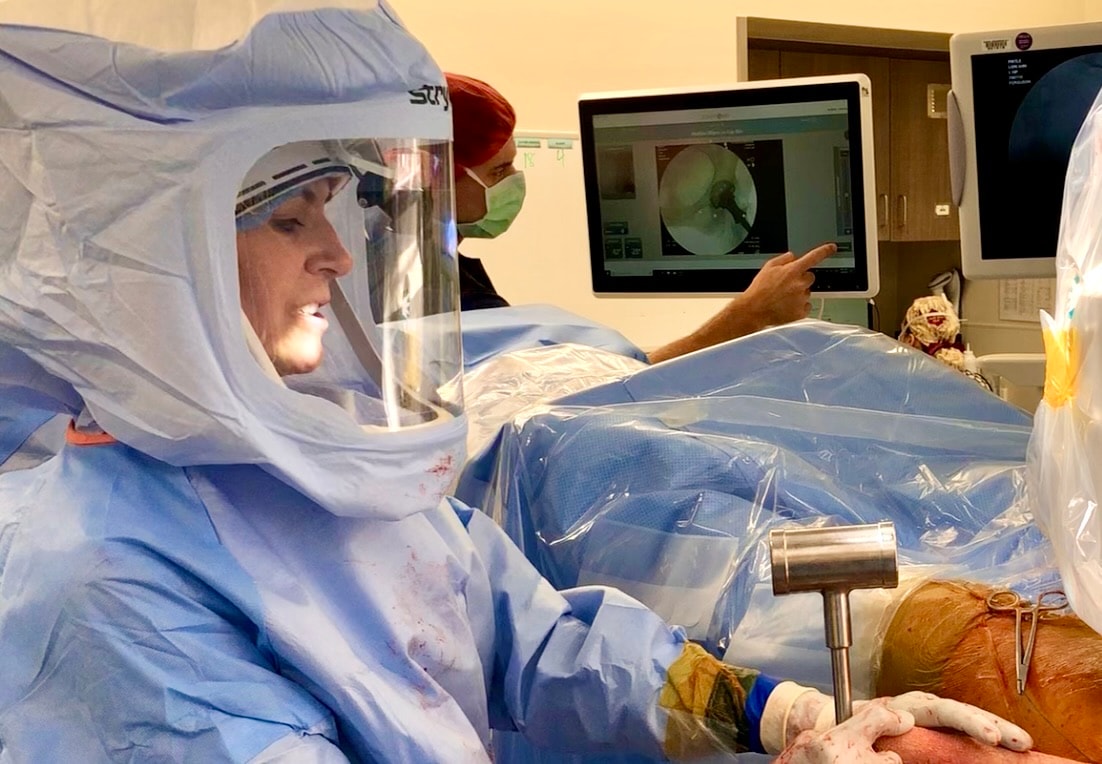
The hip is replaced through natural gaps between the muscles, so nothing is cut or detached and there are no movement precautions afterwards. Dr. Ferguson has used the anterior approach exclusively since 2004, and most of her patients go home the same day.
dislocation rate than traditional surgical approaches
10×Lower
component placement with computer-assisted navigation
2°Precision
until most patients are up and moving after surgery
4 hrsRecovery
Dr. Ferguson on Fast Track same-day hip replacementCheryl's Fast Track same-day hip replacement
The approach
Why the anterior approach
The anterior approach has grown quickly in popularity because of its outcomes. The joint is replaced without detaching any muscles from the hip or pelvis, and the implants are placed with image-guided navigation. The risk of dislocation is markedly reduced, leg length is restored more accurately, and pain after surgery is substantially less than with traditional techniques.
Muscle sparing
The hip is reached from the front through natural intervals between the muscles. The muscles that stabilize the hip stay intact, so the reported dislocation rate is ten times lower than after traditional approaches, and lasting weakness and limping are minimized.
Precise implants and leg lengths
You lie on your back on a special table (the HANA table), which allows live x-ray (fluoroscopy) during surgery to guide the implants into position.
No precautions
After traditional hip replacement, patients are told not to bend or rotate the hip for a period of time. After anterior hip replacement there are no restrictions on position or movement.
Same-day discharge
Patients walk within hours of surgery and need no IV pain medications. About 80% of Dr. Ferguson's patients go home the day of surgery.
Opioid-free recovery
Many patients need no opioid medication after they go home.
Hip arthritis and hip replacement
Hip arthritis is the loss of the cartilage surface of the joint, leading to bone-on-bone contact between the ball (femoral head) and the socket (acetabulum). The treatment is a total hip replacement, in which the joint is replaced with an artificial hip.
Precise implant positioning
A common problem with small-incision techniques is positioning the implants: with limited visibility, the socket angle and leg lengths can be off, raising the risk of dislocation, limping and uneven legs. Fluoroscopy solves this.
The socketDislocation is closely tied to the angle of the socket implant. Dr. Ferguson adjusts the preparation of the socket based on live imaging, then places the implant exactly where she wants it.
Leg length and offsetShe images the unaffected hip and the operated hip with trial implants, and overlays them to check that leg length and the hip's mechanics are restored before choosing the final implant.
Dr. Ferguson also uses JointPoint, a computer navigation system that measures socket orientation to within two degrees and leg length changes in millimeters, so she can fine-tune the implants before finalizing them.
Recovery
Because no muscles are detached and the implants are placed precisely, the hip is stable from the start and there is no reason to limit your motion. Patients generally walk and practice stairs within four hours of surgery, and most go home the same day.
Walking is the main therapy. Many patients simply start walking, then walk inclines, then gradually return to the activities hip arthritis took away, including work and competitive sport. Patients who want a therapist's help can book with the team's therapists at any time.
Morning of surgeryA medication taken before the operation blocks pain pathways.
In surgerySpinal anesthesia. You lie on your back on the HANA table while live X-ray guides the implants.
Within four hoursYou walk and practice stairs.
The same dayAbout 80% of patients go home.
Days one to threeA local anesthetic block keeps the area numb.
The weeks afterWalking is the therapy: walk, then walk inclines, then return to work and sport.
Opioid-free pain management
Opioid medications cause most of the complications that bring patients back to the hospital after hip replacement. Working with anesthesiologists and pain specialists, Dr. Ferguson developed a multimodal pain program that virtually eliminates IV narcotics, and most patients don't need oral pain medication either:
A pre-operative medication taken the morning of surgery blocks pain pathways
Spinal anesthesia during surgery avoids medication overload
No muscle damage means less pain
A local anesthetic block numbs the area for two to three days
Movement, which is the most effective way to reduce surgical pain
Cold therapy with the GameReady cold compression device
Dr. Ferguson's multimodal pain management
Your surgeon
Dr. Tania Ferguson
MD, MAS
Dr. Ferguson was among the first American surgeons to adopt the anterior approach as her exclusive technique for hip replacement, in 2004, and one of the first to practice it at a university center training residents and fellows. She has taught the technique to surgeons since 2005 and is a founding member of the Anterior Hip Foundation.
Her research extended the anterior approach to hip replacement after fractures of the hip and pelvis, and her work has been integral to its growth as the preferred technique in the United States.